

Oxford Inscriptions: Clarendon Laboratory, Parks Road
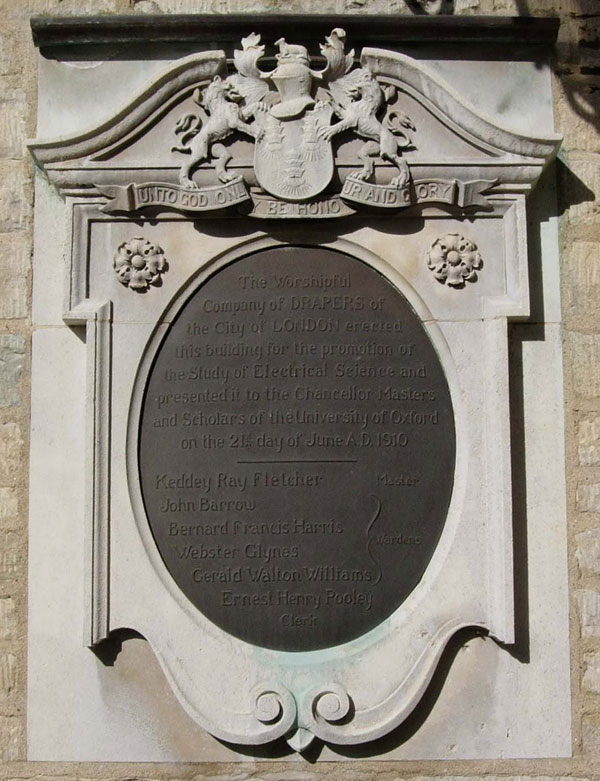
[Arms of Drapers’ Company,
with motto
“UNTO GOD ONL / Y BE
HONO / UR AND GLORY”]
The Worshipful
Company of DRAPERS of
the City of LONDON erected
this building for the promotion of
the Study of Electrical Science and
presented it to the Chancellor Masters
and Scholars of the University of Oxford
on the 21st day of June A.D. 1910
Keddey Ray Fletcher Master
John Barrow,
Bernard Francis Harris
Webster Glynes
Gerald Walton Williams Wardens
Ernest Henry Pooley
Clerk
This inscription is on the Electrical Laboratory (now part of the Clarendon Laboratory) that was designed by Sir Thomas Graham Jackson and built in 1908–1910.
This Grade II listed building was named the Townsend Building after J. S. E. Townsend, the first Wykeham Professor of Physics, for whom it was built.
This photograph of the New Clarendon Laboratory of 1948 (now known as the Lindemann Building) was taken in 1958 from Parks Road, but this view is now obscured by the Beecroft Building of 2018.
The original Old Clarendon Laboratory was completed in 1872. It was the oldest purpose-built physics laboratory in England, and was named after Edward Hyde, 1st Earl of Clarendon, whose trustees paid £10,000 for the building. Confusingly, it is no longer the Clarendon Laboratory, but is part of the Earth Sciences Department.
See Wikipedia: Clarendon Laboratory
A Royal Society of Chemistry hexagonal plaque in honour of H. G. J. Moseley, who was killed in action at Gallipoli, was unveiled on 24 September 2007 to the right of the front door of the former Electrical Laboratory (Townsend Building):
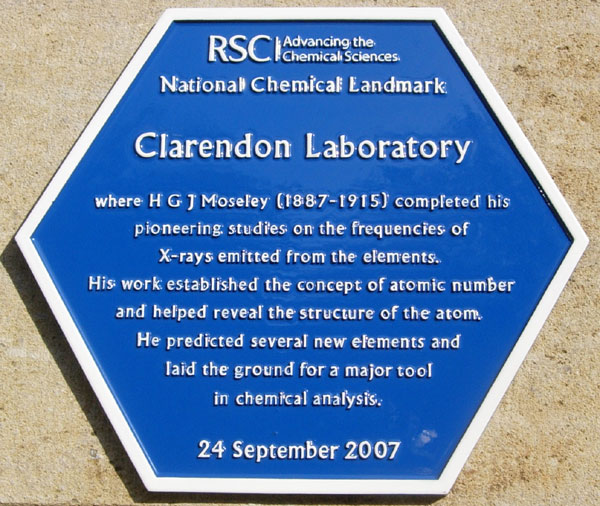
RSC | Advancing the Chemical Sciences
National Chemical Landmark
Clarendon Laboratory
where H G J Moseley (1887–1915) completed his
pioneering studies on the frequencies of
X-rays emitted from the elements.
His work established the concept of atomic number
and helped reveal the structure of the atom.
He predicted several new elements and
laid the ground for a major tool
in chemical analysis.
24 September 2007