

Oxford Inscriptions: Rewley Road Station
This metal plaque is set into the pavement in Frideswide Square and remembers the disused railway station of 1851 (modelled on the Crystal Palace) that had to be removed at the beginning of 1999 to make way for the Saïd Business School.

[This inscription goes around the four edges,
starting in the bottom left-hand corner and running up the left-hand side]:
A STATION WAS ERECTED ON THIS SITE IN 1851 BY THE BUCKINGHAMSHIRE RAILWAY TO COINCIDE WITH THE
GREAT EXHIBITION OF 1851, USING THE SAME CAST IRON COMPONENTS
THIS STATION WAS DISMANTLED AND RE-ERECTED AT QUAINTON ROAD STATION, BUCKINGHAMSHIRE BY THE
QUAINTON RAILWAY SOCIETY AS A WORKING MUSEUM IN DECEMBER 2000
Inscriptions on the central section of the plaque:
1851–1879 |
 |
1879–1922 |
[A tall image of the station’s arches |
||
1922–1948 |
1851 – 2000 |
1948–1969 |
Oxford now only has one station, namely the former Great Western Railway (GWR) station on higher ground off the Botley Road, but in the nineteenth century a rival company ran a different railway a short distance to the east, and this had its own separate station here on the site of the Saïd Business School:
- Map showing the position of the two stations (the black buildings in the centre, very near each other)
Until 1922 this second company was known as the London & North Western Railway Company (LNWR), which had absorbed the Buckinghamshire Railway. It was then taken over by the the London, Midland & Scottish Railway (LMS) which operated here from 1922 to 1948. British Railways then operated a passenger service from this station from 1948 until its centenary year of 1951.
The LNWR railway built its station here in 1851 on the site of Rewley Abbey (one year before the GWR built its own station just to the west), and it was usually described as Oxford Rewley Road Station. The photograph below (Historic England CC54/00324) shows the station in 1914:
Gardner's Directory for 1852 describes the brand-new LNWR station thus (confusingly stating that it was in the Botley Road):
The London and North Western Railway Station, also in the Botley-road, is another neat structure, of wood and iron with a glazed roof, in the style of the palace of the Great Exhibition in Hyde Park. The length of this station is 110 feet, and its breadth is about 50. This line was opened to Oxford from Bletchley, where it joins the main line, on the 16th of May 1851; but it was opened to Islip in October 1850. The distance from Oxford to Bletchley is 31½ miles. From Winslow, there is a branch to Buckingham, Brackley, and Banbury. Mr. Alfred Blott is the present station master.
The most important service run from this station was the Varsity Line, which ran from here to Cambridge via Bletchley.
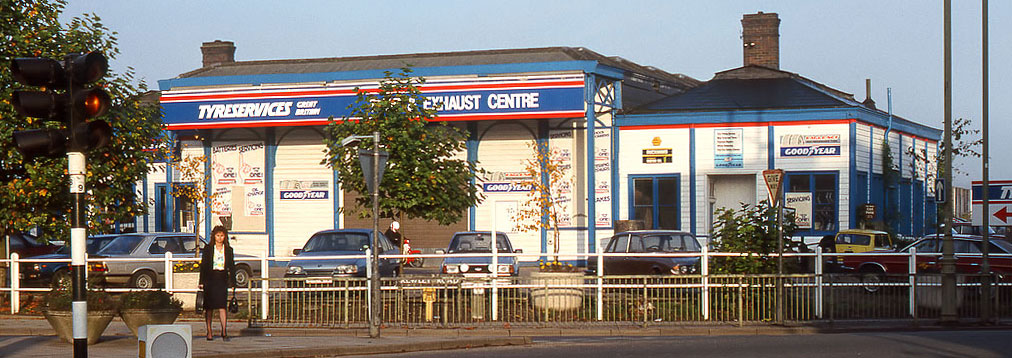
In 1948 the British Transport Commission took over the Rewley Road station and it was operated for a brief time by the Railway Executive trading as British Railways. They closed this station to passengers on 1 October 1951, putting the station building to commercial use. In its latter days it was used as a tyre-fitting business by Regional Tyre Services Ltd, as this photograph from 1988 shows:
The goods yard, however, remained open until 5 April 1984, and up to that date trains still used the Rewley Road swing bridge (now a scheduled monument) on the Sheepwash channel.
In 1998 listed building consent (98/00580/L) was granted for the demolition of the extant parts of the former LMS station of 1851 and its re-erection at Quainton in Buckinghamshire. It is now part of the Buckinghamshire Railway Centre in Quainton:
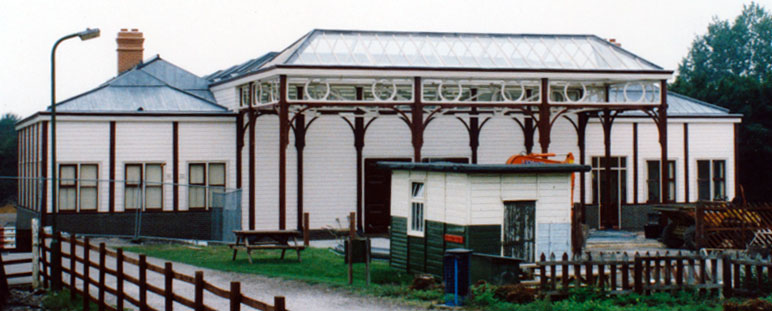
The old station building is jointly Grade II listed along with the platform, platform buildings, and bridge at Quainton (List Entry 1390836).
This Disused Stations Site Record: Oxford Rewley Road report includes a photograph of the LMS station in 1940 when it was still in operation in Oxford, and one taken in December 1967 and another in July 1994 when it was a tyre-fitting business.
The sidings and goods shed to the north of the Sheepwash Channel were also removed and the site is now occupied by a new housing development.
On 4 December 2002 a life-sized sculpture of an ox, commissioned by the University of Oxford and sculpted by Olivia Musgrave,was unveiled opposite Oxford's other station to mark the completion of the building of the Saïd Business School.
Wikipedia: Oxford Rewley Road Railway Station
Oxford's second station: Great Western Railway (GWR), on site of present Oxford Station
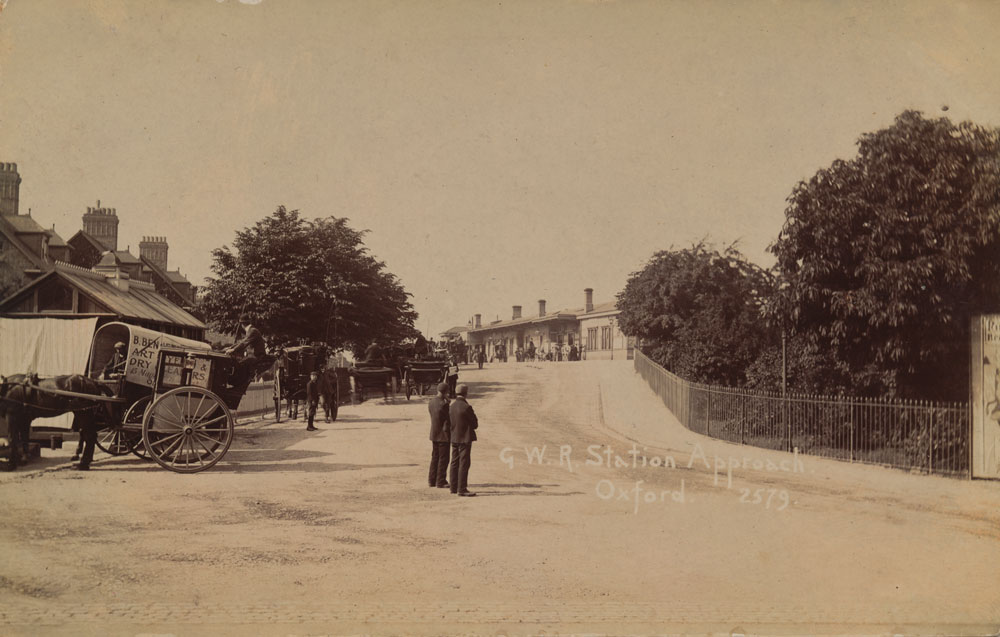
The GWR station was originally at Grandpont on what is now the corner of Marlborough and Western Roads, but in 1852 (just after the Rewley Road station was opened by its rivals) the GWR built a new one on the present Oxford station site at the junction of Park End Street and the Botley Road. This had separate entrances to east and west, and the postcard below (postmarked 25 August 1908) shows the west entrance, viewed looking north from the Botley Road.
Gardner's Directory of 1852 describes the newly built GWR station thus:
The Great Western Railway Station, situated on the Botley road, is a handsome building on both sides of the line, with a fine roof about 60 feet span, covering four lines of rail. One side of the station is appropriated to the London and the West of England traffic, and the other side is for the northern trains. Trains are dispatched from this station for London, and all parts of the south and west of England; also for Banbury, Leamington, Warwick, Birmingham, and all parts to the north. The branch to Oxford from the main line at Didcot (10 miles) was opened in June 1844, and the continuation of the branch to Banbury in September 1850, and thence to Warwick, &c., this present year. The Great Western railway company run express trains from Oxford to London in the short space of 1 hour and 10 minutes, and from Oxford to Birmingham in 1 hour and 20 minutes. The old station near the extremity of the city [Grandpont] is now used as a goods station. Mr. James Kelly is superintendent of the line.
The second entrance to the west of the station was closed in the 1960s, but for a period those with season tickets were allowed to use it, as well as those leaving the station during busy times.
The station was substantially rebuilt in 1971, and the new main building and footbridge were added in 1990.
In 2021 a notification was submitted by Network Rail for major changes to the railway station (21/02007/PA18) including the replacement of the bridge over the Botley Road. That railway bridge was installed in 2026:. Network Rail statement.
In September 2025 Network Rail advertised for an architect for the redevelopment of Oxford Station.
- Wikipedia: Oxford Railway Station
See Liz Woolley, “The coming of the railway to Oxford” for more information about the GWR railway, which originally ran through the site of Marlborough Road, and also these articles in the Oxfordshire Local History Association Bulletin:
- Vol. 6, No. 2 (Winter 1999/2000): Robert Sephton: “How the railways came to Oxford, Part 1:
“City fathers, farmers, and Folly Bridge” - Vol. 6, No. 3 (Summer 2000): Robert Sephton: “How the railways came to Oxford, Part 2:
“The University opposes: the defeat of the second Oxford & Great Western Union Railway Bill, 1838” - Vol. 6, No. 4 (Winter 2000/1): Robert Sephton: “How the railways came to Oxford, Part 3:
“Third time lucky: the GWR gets it act at last” - Vol. 9, No. 4 (Winter 2013/14): Liz Woolley, “How the railway changed Oxford” and corrections
in Vol. 10, No. 1 (Winter 2015/16): “Oxford's railways revisited”