

Oxford Milestones: Toll house on the Botley Road
The first toll house (1767–1850)
Botley Road was turnpiked in 1767 as part of the improvements of the road from Oxford to Eynsham, and a turnpike gate was set up near Osney Bridge around this time. Later in the eighteenth century, when a new coach road was built up Cumnor Hill, the Botley Road also became the first stage of the turnpike from Oxford to Faringdon. The original tollhouse near Osney Bridge had to be demolished in 1850 to make room for the Great Western Railway.
The second toll house (1850–1868)
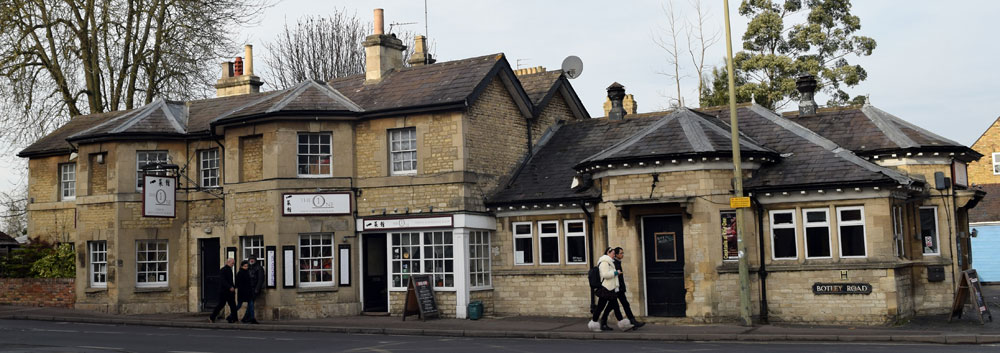
A new tollhouse (the two-storeyed building on the left above) was erected on the Botley Road in 1850 between Abbey Road and Cripley Road. It was designed by H. J. Underwood and built by Mr Sherwood. It is not a listed building.
Just eighteen years later in 1868 the turnpike gate was moved to the west of Binsey Lane, and this toll house was converted into a pub called the Old Gatehouse. In 1874 it was enlarged and improved to a design by Field & Castle, with the building work by Knowles & Son.
A further single-storey extension to the east was added in 1902 by the Oxford architect J. R. Wilkins, and this is sometimes mistaken for the toll house.
The photograph below of the new 1902 extension was taken by Henry Taunt in 1906:
In December 2016 these premises were occupied by “The One”
The third toll house (1868–1880)
This toll house was near Binsey Lane from 1868. The adjacent Botley turnpike gate was a great inconvenience to the poor people who lived in the houses that had sprung up just beyond it, as detailed in Jackson's Oxford Journal on 21 November 1874. Even the smallest vehicle could not pass it without paying 6d. or 8d.
The turnpike gate moved to the foot of Cumnor Hill in 1877, but just three years later the Oxford to Faringdon Road was deturnpiked.