

North wall between Ship Street and Broad Street,
with Bastions 4 & 5
Broad Street was just outside the city, and the line of the north wall is on the boundary line of the backs of the buildings on the south side of Broad Street (which were then outside the city) and the backs of those on the north side of Ship Street, which was within the city.
There used to be a lane outside the city wall, and then a deep man-made moat or ditch (known as the Candida Fossa or Canditch) which ran along the back of the present shops on the south side of Broad Street and also along the present George Street, thus completing a circuit of flowing water around the city walls.
Bastion 4: The Martyrs' Bastion
This bastion cannot be seen from the road and is on private property. It is at the point where the backs of Jesus College's Ship Street Centre and the Mountain Warehouse shop at 6 Broad Street meet, and is adjacent to The Store Hotel (map). It used to be a highlight of the train ride of the Oxford Story that between 1986 and 2007 operated from 6 Broad Street and the present Jesus College site behind.
It is a Grade I listed structure (List Entry No. 1184408).
This drawing shows what this bastion would have looked like in earlier days (Historic England HT10306):
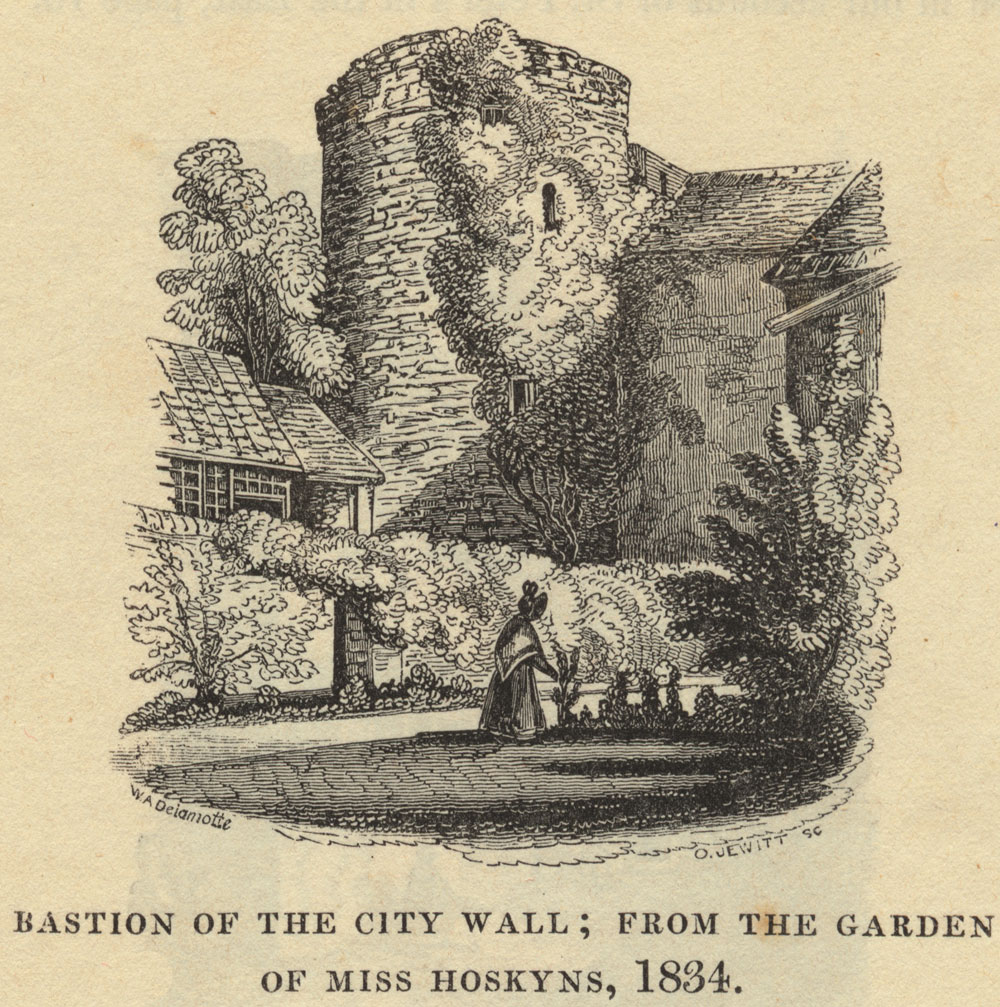
The drawing below by W. A. Delamotte (engraved by Orlando Jewitt) shows this bastion in 1834, when it was visible from Miss Hoskyns’s garden at 4 Broad Street (one of the houses demolished to make way for Boswell House, now the Store Hotel).
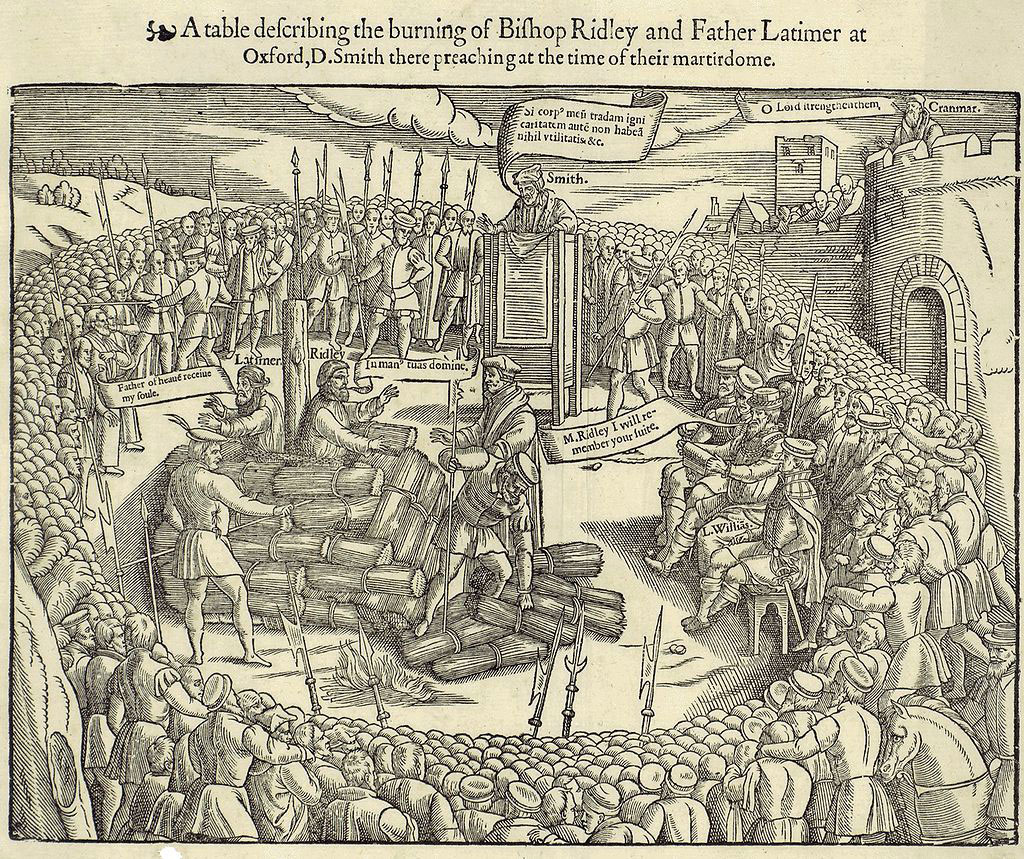
It became known as the Martyrs' Bastion because of the belief that Archbishop Thomas Cranmer (one of the Protestant martyrs remembered on the Martyrs' Memorial) had been imprisoned inside this bastion for a period before his death and was made to stand at the top of it to watch the burning of Bishops Ridley and Latimer in Broad Street on 16 October 1555, as illustrated here in Foxe's Book of Martyrs:
This idea was refuted by G. A. Rowell (the Keeper of the University Museum) in a long letter published in Jackson's Oxford Journal on 18 September 1875:
Perhaps some [modern antiquaries] have been misled by the idea that the bastion at the back of Mr. Dudley's house [6 Broad Street] was the prison in which Cranmer was confined, and that he saw and addressed Ridley and Latimer from the top of it; whereas the bastion is simply a semi-circle in the wall, similar to those in New College Gardens, and could in no way have been connected with Bocardo Prison.
People continued to believe that Cranmer had been imprisoned in this bastion, and the following report appeared in Jackson's Oxford Journal on 20 August 1881:
THE “BISHOPS' HOLE.”—Mr. W. Baker, upholsterer and furnisher, of Broad-Street, the new possessor of the Ship Hotel and adjoining premises, has, it is understood, no intention to destroy the “Bishops' Hole” or “Bocardo,” situated at the rear of the former — indeed, has been making arrangements for its retention in its primitive form — so that the public who visit Oxford may still have an opportunity of inspecting the spot so painfully associated with the last days of Cranmer, Ridley, and Latimer.
– Messrs. Shrimpton and Son, of Broad-street, have had a sketch taken of the ancient prison.
On 11 March 1882 the newspaper reported on a meeting of the Oxford Architectural & Historical Society:
the party went to visit the so-called Cranmer bastion, by the kind permission of Mr. Baker. James Parker, Esq., gave the Society a short account of this interesting feature, showing that it belonged not to the original wall, but to a second enlargement of it made probably about the beginning of the 15th century, so as to surround the newly-built north aisle of S. Michael's. Mr. Parker was decidedly of opinion that Cranmer was not incarcerated here, but in the Bocardo prison, which has long since been destroyed.
The furniture salesman William Baker had gone into partnership with his brother-in-law Nehemiah Harry Prior of Queen Street, and on 14 October 1882 they advertised the use they were making of this bastion, which they now owned:
Baker and Prior's new show rooms are now completed. They comprise four floors, each about 120ft. by 25ft., inclusive of Three Floors in the Old Martyr's Bastion. This Addition to their Premises gives them in all about 40,000 Superficial Feet of Flooring, for Show Room Purposes, and has enabled them so to arrange their HUGE STOCK, that each Article may be seen to the best advantage.
See “Bastion No. 4 and Baker’s Warehouse, Ship Street, Oxford”, a report by Oxford Archaeology for the Clarkson Alliance on behalf of Jesus College (March 2010)
The two photographs below show this bastion in 1907:
Historic England HT10593:
Historic England CC51/00441:
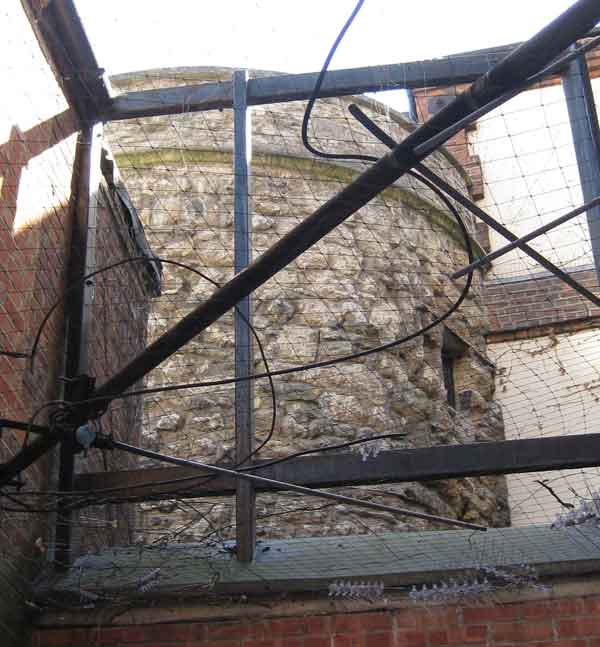
In recent times this view of the bastion could be seen from Broad Street when the gate to the yard of the former Boswell's shop was open:
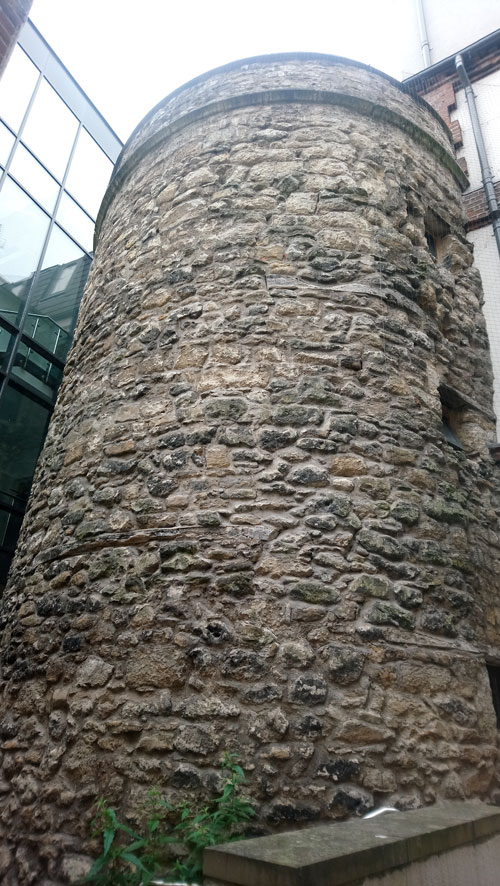
Below is the view of this bastion from the Ship Street Centre of Jesus College (no access without invitation):
Bastion 5
This survives at the back boundary of 17 Broad Street (now Oxfam) and 14–15 Ship Street (the appropriately named Tower House Hotel), and is part of the latter's kitchen. It is a Grade II listed structure (List Entry No. 1047090).
The photograph below (Historic England CC51/00437) taken in 1905 shows a brick building on the foundations and lower wall of this medieval bastion:
Photograph taken from the Bodleian Library showing excavations of the city wall at 17 Broad Street (Historic England CC51/00434):

The wall to the east of Bastion 5
The photograph on the right, taken from the Hub on the corner of Ship Street and Turl Street, looks down on the outdoor seating area of the ItaliAmo Ltd restaurant at 22 Broad Street. It shows a small portion of the city wall to the east of Bastion 5.
Twirling postern gate
At the end of Ship Street was the twirling postern gate in the wall (designed to keep cattle out of the town) that gave Turl Street its name. It was demolished in 1722.
From Turl Street to the Smith Gate at Catte Street
The continuation of the wall to the south of Broad Street after the junction with Turl Street has disappeared because of the large and important buildings that were built straddling its line, namely Exeter College, the Museum of the History of Science, and the Sheldonian Theatre.
The drawing below, taken from an article entitled “Excavations in the Clarendon Quadrangle” published in Jackson's Oxford Journal on 18 November 1899, shows how what would have been Bastion No. 6 stood at the north-west end of the Bodleian Library before the wall turned north-east to meet the present Catte Street opposite the Smith Gate.
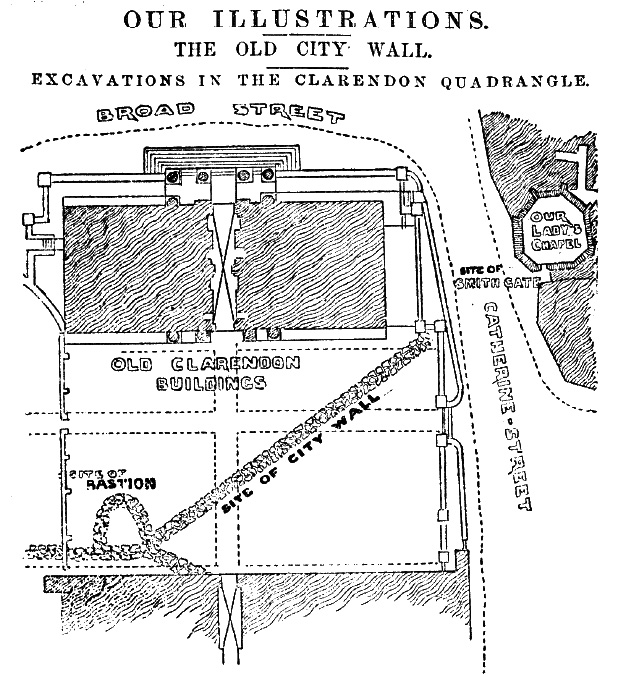
The remains of the city wall south of the Clarendon Building were excavated more thoroughly in 1938/9, and there is a detailed report available online:
- J. Daniel: “The City Wall and Ditch in the Clarendon Quadrangle” (Oxoniensia Vol. IV, 1939)
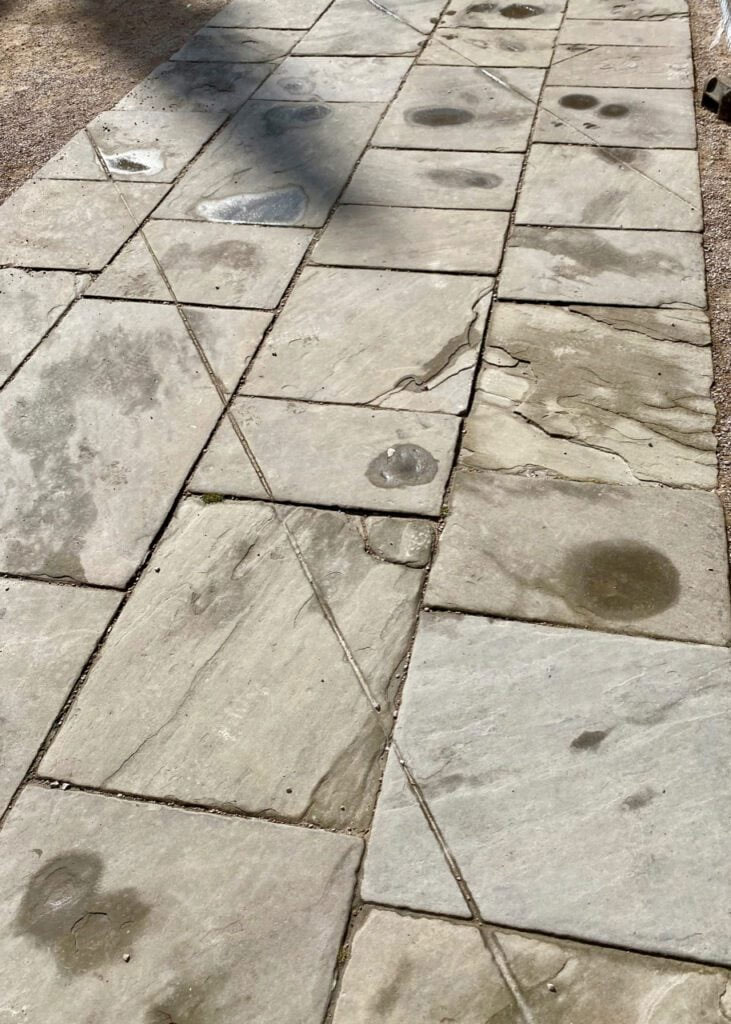
The path of the city wall is marked with lines on the present paving:
Next: Smith Gate in Catte Street
